How does evidence become credible?
The book follows claims through perception, testimony, records, interpretation, and the institutions that authorize them.
BOOK_003 / FIRST EDITION
A new book by James Allister Odd
What Happens Between Seeing and Believing
A provocative, accessible inquiry into what happens between seeing and believing—how information becomes accepted truth, public authority, and consequence.
THE PROBLEM
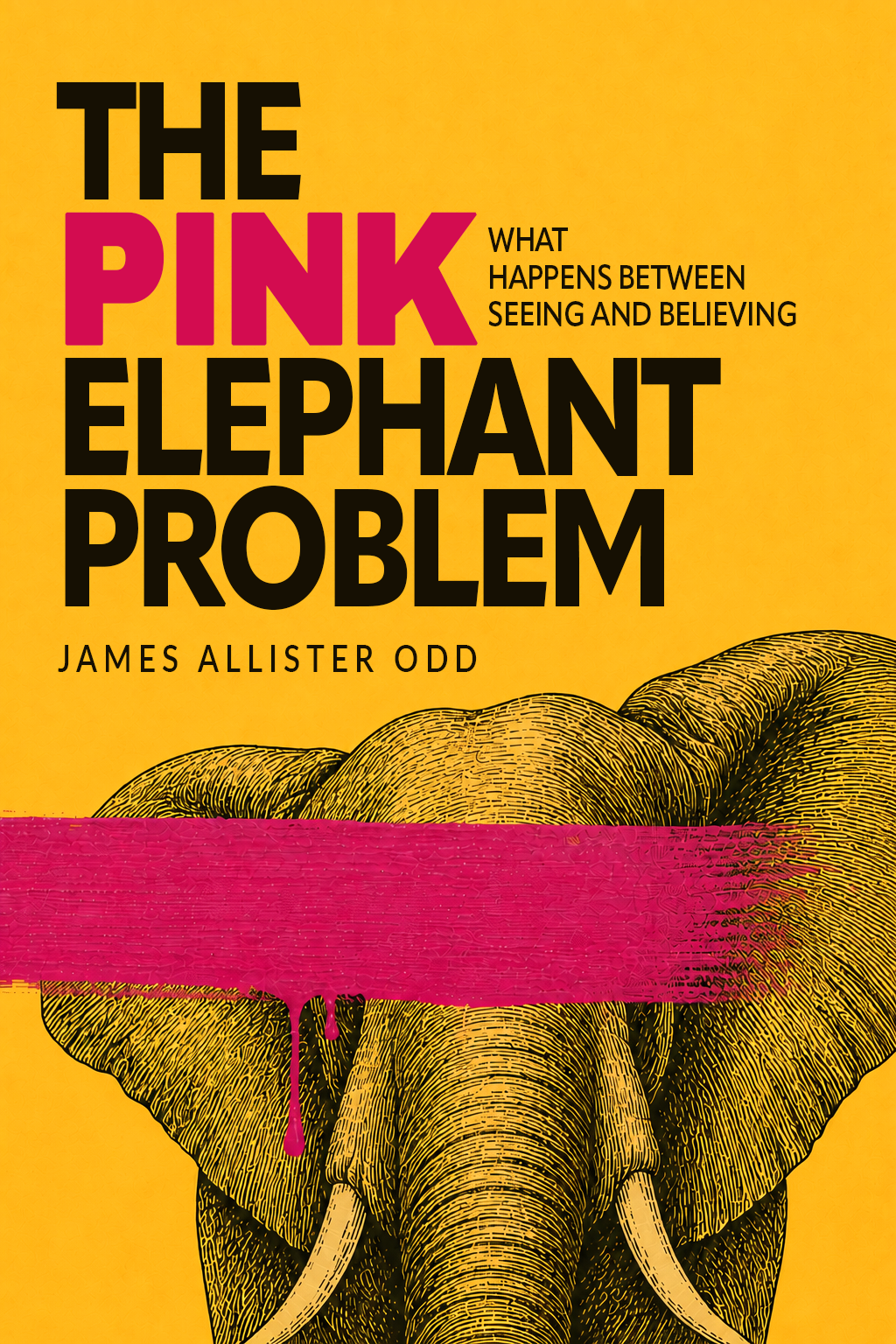
An elephant stands before you, unmistakably pink. An authoritative guide explains that it is rare, naturally colored, and extraordinarily valuable. Then the paint begins to run.
What changed? The elephant was pink when you saw it. But the explanation that made its color meaningful was false.
That gap—between what reaches us and what becomes true enough to organize our lives—is the subject of The Pink Elephant Problem. Every claim arrives through perception, memory, emotion, language, culture, testimony, and institutions. Before it can guide action, it must pass through an individual. Yet individual judgments do not remain private. They become records, classifications, prices, histories, orthodoxies, permissions, and public consequences.
Drawing on examples from luxury branding, bank runs, scientific classification, religious upheaval, legal evidence, historical memory, and synthetic media, James Allister Odd follows belief as it moves from one mind into systems of authority. He asks how evidence becomes credible, why apparent consensus can conceal private doubt, when acceptance changes behavior or social reality, and what remains stubbornly independent of what anyone believes.
This is not an argument that every belief is equally true, nor a promise that perfect objectivity is available if we simply try harder. It is an investigation of the difficult ground between those positions: the place where facts, filters, institutions, and power meet.
Written for curious readers rather than specialists, The Pink Elephant Problem asks a provocative question with practical consequences: What can correction repair after belief has already changed the world?
THREE PRESSURE POINTS
The book follows claims through perception, testimony, records, interpretation, and the institutions that authorize them.
Public certainty may organize behavior even when the people producing it privately doubt the story they appear to share.
Acceptance can move prices, empty banks, establish classifications, shape histories, and make correction arrive too late to restore the earlier world.
Luxury branding / bank runs / scientific classification / religious upheaval / legal evidence / historical memory / synthetic media
THE GROUND BETWEEN
The book stays with the difficult middle: the place where facts, filters, institutions, and power meet—and where what remains true can diverge from what has become consequential.
CONTENTS
Author's Introduction
A Reader's Admission Audit
PUBLICATION RECORD